
Digital marketing is evolving rapidly. In the past, advertisers largely targeted search engines such as Google. Now, many people also rely on AI tools like ChatGPT, Gemini, and Claude to find answers. These AI tools read content in their own way. For this reason, a new concept is gaining importance: LLM content optimization. Marketers need to think about this right now.
Optimizing your LLM content means creating content that AI tools, such as machine learning and NLP, can read. There are no magic tricks or shortcuts. It is nothing more than writing clear, seamless content that editor AIs can trust.
In this post, we explain everything that goes into optimizing LLM content. You will find out why it’s important, what it is, how it works, and how it can make a marketer’s job easier. This guide is suitable for beginners and seasoned marketers alike.
LLM content optimization involves making content digestible and simple for AI tools such as ChatGPT, Gemini, and Claude to read, understand, and respond to. Many people now conduct searches by posing questions to AI rather than clicking links on a website. So content needs to be easy to understand and well-organized. Content optimization for LLMs is about writing naturally and conversationally.
It relies on short paragraphs, clear subheads, bullet points, and direct answers. The aim is to help AI quickly discover the main broadcast message of your content. This kind of optimization is a contrast to standard SEO, which is only for search engines. By optimizing your LLM for content, you’re creating helpful content that both humans and their AI recommendation bots can trust.
Is an LLM good for users? Because how people search for information has totally changed. Today, they want quick, easy, and clear answers, not to click through dozens of links.
They’re easily confused, but search engine optimization and LLM optimization are different creatures. It is essential to understand the distinction between SEO and LLM optimization.
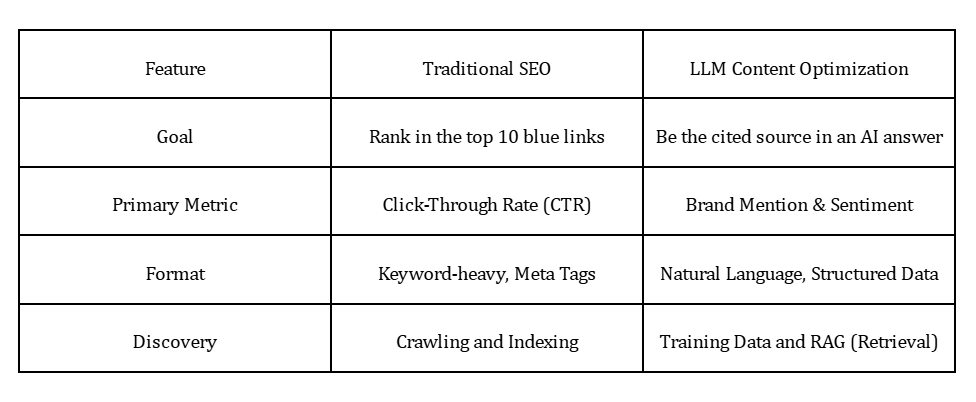
In SEO vs LLM Optimization, the first is interested in 'where' you are on a page, and the second is most interested in 'how' AI describes you. You require both to win in 2024 and beyond.
It will take some LLM optimization tricks to reach that. Here are the foundational pillars:
LLMs love facts. And make good use of hard data, figures, and clear definitions, rather than fuzzy marketing twaddle. The LLM’s format prioritises content over snappy marketing copy, based on “Who, What, Where and Why”.
Adobe LLM optimizer is one such tool. This is what enables the model to effortlessly locate prices, ratings, and features for products. The masses are starting to understand that, for those who want to check, their data is structurally sound for machine readability.
LLMs are trained on the “whole internet,” but they prefer high-authority sources. If Wikipedia, Reddit, and big news publishers are talking about your brand, an LLM will likely be willing to believe you.
In the video on LLM content optimization tutorial, the first thing to keep in mind is that you need to be direct and answer question. Use the “Lead with the Answer” technique. If your article is called “How to bake a cake,” then the first sentence should be something about the essential steps followed.
It takes more than scribbling to develop a strategy. What you need is a method to optimize your LLM's content.
Conceptualize your brand as an "Entity." An LLM sees the world as nodes and links. If you are a skincare brand, you want the LLM to associate your "Entity" with terms like "organic," "dermatologist-tested," and "sustainable." You do this by repeating these forces across all media channels.
Specialized tools are becoming increasingly popular among many businesses. The adobe LLM optimizer (and similar next-gen tech) enables marketers to effectively "try on an LLM" and see how their brand is perceived. With the help of the adobe LLM optimizer, you can locate "content gaps" – scenarios where the AI might mistakenly recognize something about your services.
And because LLMs are trained on human conversation, your copy should sound human. Don't fall for keyword stuffing, an outdated SEO tactic. Rather, apply LLM optimization methods such as latent semantic indexing (LSI), which employs words associated with the main topic.
Now, to see what true content optimization with the LLM entails, let’s take a look at some real-world dumb-down examples.
But now that you’ve heard the foundation of this LLM guide, we’ll move on to some small, easy changes you can make.
This is the era of AI discovery. If you want to keep seeing success as a marketer, you need to get comfortable with LLM optimization and understand how it differs from traditional SEO. The goal is no longer just to rank as a link on a page, but to become the clear, trusted answer AI tools surface first.
Regardless of the tools you use, the objective remains the same: deliver content that is clear, useful, and reliable. To simplify this process, you can work with LazyySEO, a platform built to share practical, up-to-date insights on SEO and AI-driven content optimization.
If you are looking for SEO services, AEO Services that go beyond rankings and focus on AI visibility, or if you need SEO retainer services designed for consistent, long-term growth, our team can help. Contact us to discuss how we can optimize your content for both search engines and AI-powered discovery.
.svg)
.svg)
.svg)

.svg)